



Pylon Signs – types, benefits and how to choose the right one
A pylon sign is a freestanding structure that helps businesses increase their visibility, showcase their brand, and make their location easier to find. Its height and size make it visible from a distance, which is why pylons are commonly placed near shopping centers, supermarkets, gas stations, and company premises. What purpose does a pylon sign serve? What types are available, and what other signage can help create a consistent brand identity?
Outdoor advertising continues to play an important role in the marketing landscape, with brands increasingly investing in ways to reach consumers beyond digital channels. According to the latest data from Outsmart, the UK's Out of Home (OOH) advertising market generated £402.6 million in revenue in the second quarter of 2026, representing a 12.7% increase compared to the same period in 2025.
The growing interest in offline communication highlights the importance of a brand's visibility in public spaces. Pylon signs are one effective way to strengthen your brand's presence and attract attention. Find out how to make the most of them and what to consider when choosing the right structure.
Pylon sign – the first point of contact with the brand
An advertising pylon is a freestanding, usually vertical visual information display used to present a company name, logo, offer or identify a property. In everyday language, a pylon is also sometimes referred to as an advertising pillar, as both structures have a similar form – vertical constructions installed outside buildings to display advertising or informational content. An advertising pylon typically takes the form of a tall structure resembling a pole, tower or column. Thanks to its size, it remains visible from a considerable distance, even when the building is partially obscured by other objects.
Pylons belong to the category of outdoor advertising. They are most often found in front of supermarkets, shopping centers, gas stations, car dealerships, and service facilities. They are installed at entrances, parking lots, and access roads. They can display the logo of one brand, the names of several tenants, or information about available services.
However, a pylon is more than just a large sign. A well-designed one helps the recipient to:
find a company or commercial facility;
recognize the brand before reaching the building;
find the correct entrance, parking lot, or service point;
familiarize themselves with basic information about the offer.
For a company, this means combining advertising, informational, and navigational functions. This is especially important in places where the recipient has little time to familiarize themselves with the message, for example, while driving.
How is a pylon sign constructed?
The pylon's construction depends on its purpose, dimensions, location, and method of presenting content. It usually consists of several basic elements:
Supporting structure – responsible for the object's stability. It is made of appropriately selected steel or aluminum elements.
Casing – gives the pylon its final shape and appearance. It can be made of aluminum, sheet metal, or other materials intended for outdoor use.
Advertising surface – used to display the logo, company name, and information about the offer.
Lighting system – in illuminated models, it ensures the visibility of the message after dark.
Mounting elements – enable stable embedding of the structure, most often on a properly prepared foundation.
The graphic design also plays an important role. The logo should be distinct, the contrast appropriately chosen, and the messages short and legible. Even a solid structure will not fulfill its function if the recipient is unable to quickly read the presented information.
Main types of pylon signs
Pylons come in different designs, with various lighting options and ways of displaying information. The right choice depends primarily on where the pylon will be installed and what purpose it needs to serve. So, what options are worth considering?
Illuminated pylon signs
If you want the signage to be visible after dark, a pylon with LED lighting will be a good choice. Backlighting makes the logo, company name, and other graphic elements legible regardless of the time of day. It can also be combined with 3D spatial letters, which give the structure a more distinctive character.
LED light advertising will be particularly useful in places where customer traffic also occurs in the evening and at night. This includes, among others, gas stations, supermarkets, 24-hour service points, and commercial facilities along busy routes.
The backlighting method can be adapted to the design. Light can cover the entire advertising surface, selected graphic elements, or spatial letters and signs.
Static pylons (non-illuminated)
A pylon doesn't always need to be illuminated to serve its purpose effectively. If it's mainly viewed during daylight hours or located in an area with sufficient external lighting, a non-illuminated version can work just as well.
Non-illuminated pylons are used, among others, at office buildings, service facilities, and on company premises. They allow the company name, logo, or directional information to be displayed without the need for LED installations.
In this case, materials, colors, and contrast are particularly important. Appropriately selected elements ensure the legibility of the message and allow the structure to be adapted to its surroundings.
Single-sided and double-sided pylons
Depending on the location and direction of customer traffic, you can choose a single-sided or double-sided pylon sign.
A single-sided pylon displays information on one side, making it a good choice for routes where visitors approach from a specific direction. A double-sided pylon, by contrast, is visible from both directions, making it ideal for roads, car parks, and facility entrances.
When choosing a pylon, consider where it will be positioned and how easily visitors will be able to see and read the information.
Pylon signs with replaceable design
If the object's offer or tenant list often changes, a pylon with interchangeable graphic elements will be a good solution. It allows information to be updated without the need to replace the entire structure.
Such pylon signs are suitable for retail parks, galleries, and service complexes. They can display tenant logos, brand names, or available services, while also making it easier to adapt the signage to the current offer.
Where do pylon signs work best?
Pylon signs are particularly useful in places where the building is not clearly visible from the main road or where the customer needs an additional hint to reach their destination.
However, their use is not limited to large retail chains. They can support communication for both recognizable brands and local businesses.
1. Pylon signs in front of supermarkets and stores
For retail chains, outdoor advertising plays an important role in building recognition and facilitating the location of outlets.
Large supermarkets are often located in commercial complexes, on busy streets, or on the outskirts of cities. The building itself is not always visible from an adequate distance, especially when obscured by other objects, trees, or road infrastructure.
A tall pylon sign can serve as a landmark in such a place. It displays the chain's logo, store name, and key information, allowing customers to quickly recognize the location. What's more, a pylon can present several brands simultaneously. This is particularly useful in retail parks where many tenants operate in one area.
From the perspective of the property owner, this means the ability to organize signage and create a coherent visual identification system.
2. Signage for shopping centers and retail parks
Shopping centers and retail parks are spaces where visual communication must meet the needs of various target groups. A customer may be looking for a specific store, restaurant, order pickup point, or parking entrance. In such conditions, a single sign on the facade is often not enough.
Pylons and totem signs make it easier for visitors to navigate a space from the moment they arrive. They can display tenant names, directional information, and zone identifiers.
However, it's important to establish a clear hierarchy of information. The most prominent messages should be those visitors need to see first. Additional details can be placed further down or displayed on other signage elements. This way, the pylon doesn't become an overcrowded collection of logos, but an integral part of a well-designed wayfinding system.
3. Pylons at gas stations and service facilities
Gas stations are one of the most characteristic examples of using tall advertising media. A pylon can display the operator's logo, information about available services, and selected elements of the offer. Similar applications are found at car dealerships, hotels, restaurants, medical facilities, or customer service points.
In these places, quick recognition of the object is paramount. The recipient often has little time to familiarize themselves with the message, so the communication should be simple and clear.
4. Pylons as an element of corporate visual identity
A pylon sign can also be an important element of a company's coherent image. A properly designed structure allows the brand's visual identity to be extended beyond the building. Colors, typography, logo, and characteristic graphic elements can refer to the company's other advertising materials.
This is particularly important for companies with multiple branches. A repeatable way of marking facilities helps customers recognize the brand in different locations.
It is therefore worth treating the pylon as part of a larger visual communication system, and not as a single medium ordered without reference to other identification elements.
A pylon is just the beginning – what other display solutions can make your brand stand out?
Noticing a brand from the road is just the first stage of contact with the customer. When the recipient reaches a store, showroom, gallery, or service point, their attention is drawn to subsequent elements of visual communication.
This is where totem signs, stands, and exhibition systems come into play. Each of these media can fulfill a slightly different function, but all help build a consistent brand experience.
Pylon vs. totem sign – what's the difference?
Both totem signs and pylon signs are freestanding display systems that help expose a brand and convey information. Although the names are often used interchangeably, these structures can differ in form, size, and purpose.
Pylons are usually larger and more massive. Their primary purpose is to ensure visibility from a long distance, which is why they are often found by roads, shopping centers, and company headquarters.
Totem signs usually have a more compact and slender form. They can display logos, offers, promotional messages, or navigational directions. They work well both outdoors and indoors – including in showrooms, shopping malls, at trade fair stands, and during events.
Depending on the design, a totem can serve not only an informational function but also an image-building and decorative one. Therefore, it is worth treating it as a complement to signage that helps maintain consistency in brand communication across different spaces.
Exhibition stands – how to make your offer stand out at the point of sale?
While a pylon helps locate an object, an exhibition stand allows you to focus attention on a specific product or message.
Stands are used in shops, shopping malls, service points, showrooms, and during industry events. They can present new products, current promotions, informational materials, or product samples.
Their advantage is the ability to place a message directly in the space where the customer makes a purchasing decision.
In practice, a stand can:
highlight a selected product category;
inform about a promotion or new product;
present an offer in an organized way;
attract attention in a high-traffic area;
make it easier for the recipient to familiarize themselves with the most important features of the product.
An aexhibition stand should be tailored to the nature of the presented offer. It is worth ensuring appropriate graphic size, message readability, and construction stability. More about what an exhibition stand is can be found on our blog.
adsystem exhibition systems – many more possibilities
It is worth remembering that the world of visual advertising does not end with classic pylons, totems, and stands. The adsystem offer includes many diverse exhibition systems that can be adapted to the brand's character, the specifics of the area, and the campaign's goal. In addition to standard solutions, more unconventional, and even "crazy" constructions are also available, which allow you to stand out from the competition and attract the attention of recipients with an unusual form.
Such solutions can become not only an advertising medium but also an element of space arrangement and a memorable brand experience. It is worth exploring the possibilities offered by adsystem's exhibition systems, and seeing how many creative ways to present a brand can be used.
Advertising doesn't have to be boring! Discover creative display systems that capture attention, make your brand stand out, and help you break away from the ordinary.
How to combine outdoor advertising with indoor display?
The best results come from a consistent approach to visual communication. Instead of treating each medium as a separate element, it is worth planning them as parts of a larger system.
For example, a brand operating a store in a retail park can use several solutions:
Pylon signs at the entrance – facilitates finding the object and exposes the brand name.
Information totem sign at the entrance – helps indicate the store's location or the most important points within the complex.
Exhibition stand at the point of sale – presents a specific offer, product, or promotion.
Display system during promotional events – allows for expanding brand communication and presenting its offer in an attractive space.
In each of these places, it is worth maintaining consistency in color, typography, and graphic style. This way, the recipient recognizes the brand regardless of whether they see its signage by the road, in a store, or at a trade fair.
What to consider when choosing a pylon sign?
The selection of a pylon should begin with defining its function, location, and target audience. Only then can decisions be made about dimensions, materials, backlighting method, and graphic design.
Dimensions and location of the structure
The height and width of the pylon should be adapted to the installation site and the distance from which recipients will view the advertisement. A different solution will work for a small service point than for a large retail park located by a busy road.
Before choosing, it is worth analyzing:
distance from main communication routes;
directions of pedestrian and car traffic;
presence of buildings and other obstacles limiting visibility;
availability of space for the structure;
local spatial conditions.
The height of the pylon should not be chosen according to the principle of "the higher, the better." The structure must be legible, proportionate to its surroundings, and compliant with applicable requirements.
Materials and weather resistance
A pylon intended for outdoor display must be prepared for many years of use in varying conditions.
The resistance of materials to moisture, solar radiation, temperature changes, wind, and pollution is important. Attention should be paid to the quality of the casing, anti-corrosion protection, tightness of lighting elements, and water drainage method. Easy access to elements requiring periodic maintenance is also important. Efficient servicing helps maintain the structure in good technical condition and can reduce its operating costs.
An alternative to a traditional pylon signs can also be an outdoor advertising wall – a solution that allows for effective brand exposure also in outdoor spaces.
Type of backlighting and message readability
If the pylon is to be visible after dark, it is worth ensuring a properly selected lighting system. LED modules should provide uniform illumination, without unsightly light leaks and differences in brightness.
Color scheme is also important. The logo and company name should stand out against the structure, and the most important information must be readable in a short time.
In the case of advertising aimed at drivers, limiting the number of messages is particularly important. The pylon should not require prolonged attention.
Graphic design and consistency with visual identity
A pylon is a large element of space, so its appearance should match the brand's character and refer to other advertising materials.
Designs with a clear hierarchy of information work best. The logo, company name, and most important message should be clearly visible, and additional content should not distract from them.
In the case of multi-brand objects, it is also necessary to ensure a clear division of space. Individual logos should form an organized whole, instead of competing with each other for the recipient's attention.
Installation, safety, and formalities
Pylon installation requires consideration of technical and location conditions. For larger structures, the foundation, wind loads, stability, and proper execution of the electrical installation are particularly important.
Before implementation, formal requirements should also be checked. Depending on the dimensions, construction, location, and method of foundation, provisions of the Building Law, local regulations regarding advertising, and regulations related to landscape protection may apply.
Not every pylon requires an identical administrative procedure. Therefore, before starting the investment, it is worth verifying the requirements for a specific project and location.
Brand visibility starts with good signage
Pylon, totem, or exhibition stand – each of these media can serve a different function, but all support brand visibility and recognition. For visual communication to be consistent at every stage of customer contact, it is worth combining external signage with solutions used inside the facility. Diverse exhibition systems allow not only to present the offer but also to highlight the most important zones, organize space, and strengthen the company's visual identity.
When planning signage, it is therefore worth looking at the space as a whole and considering which solutions will best meet the needs of the enterprise, the specifics of the location, and the character of the brand. The largest or most extensive structure will not always be the best choice. The most important aspects are clear communication, functionality, and consistency in building the image – so that every element of communication, from the first contact with the brand to the presentation of its offer, creates a coherent experience.

- Original Shapes exhibition systemsOutdoor advertising
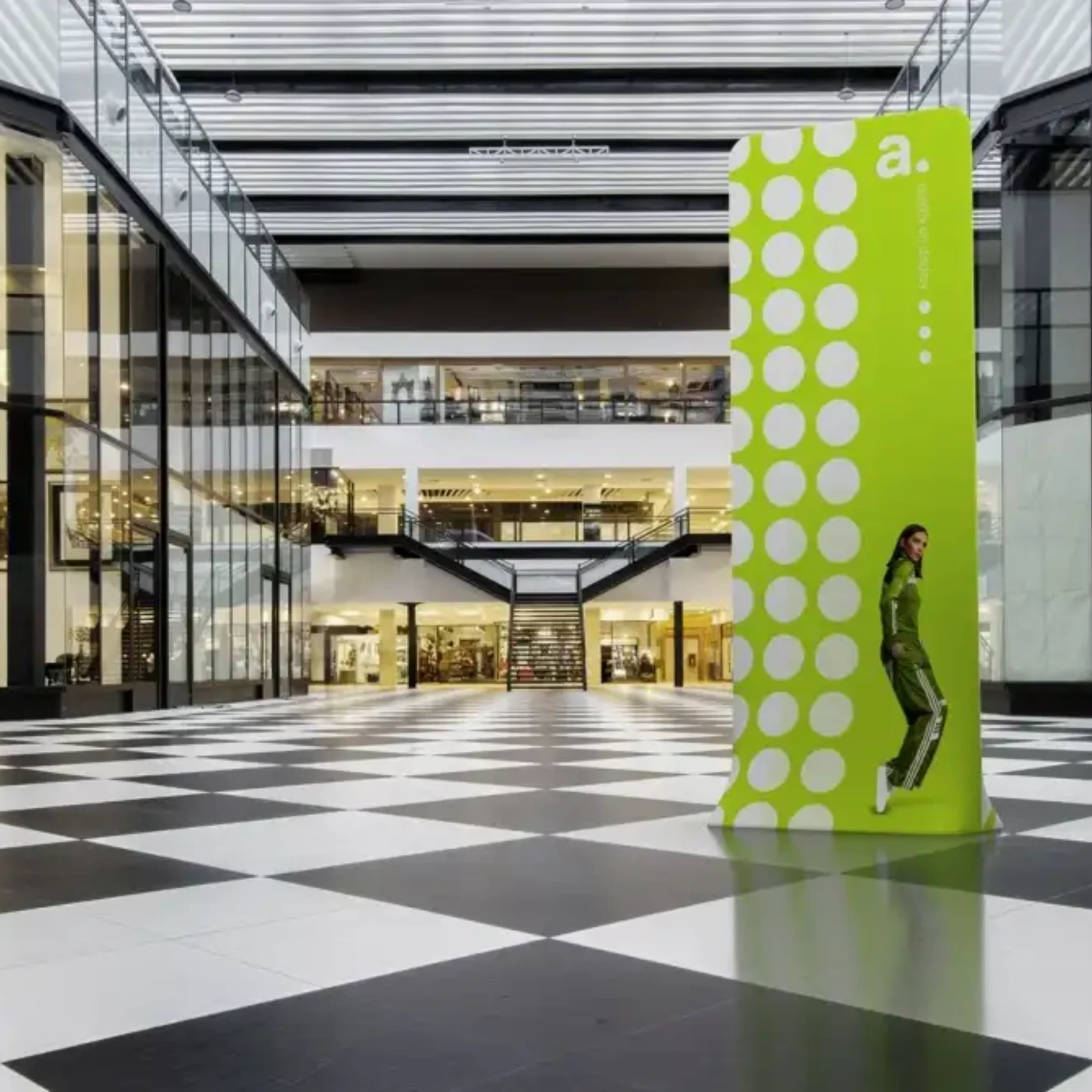 Pylon Signs – types, benefits and how to choose the right one
An advertising pylon is a freestanding structure that helps a company stand out in space, displays its logo, and makes it easier for customers to find its location. Thanks to its large dimensions, it is visible from a greater distance, which is why it can often be found near shopping centers, supermarkets, gas stations, or company headquarters. What functions does it perform, what are its types, and what should be added to the signage to create a coherent brand communication system?
- Outdoor advertising
 Winter events: 5 rules to save your booth from rain and snow
Winter isn’t for the faint-hearted — especially when it comes to outdoor events, where snow and wind can test even the best ideas. But don’t worry — with the right outdoor systems, your booth can become a safe, dry, and eye-catching base. Here are five rules that will make sure no weather ruins your plans.
- Outdoor advertising

- Outdoor advertising
 Advertising flags at autumn events – how to stay visible in changing weather conditions
The autumn–winter season is a challenge for any form of outdoor advertising. Wind, rain, and shorter days can easily make your message disappear from sight. But an advertising flag? With the right structure and material, it’s more than ready for the job. Don’t let bad weather overshadow your brand – learn how to use advertising flags effectively even in difficult weather conditions.
- Advertising wallsOutdoor advertising
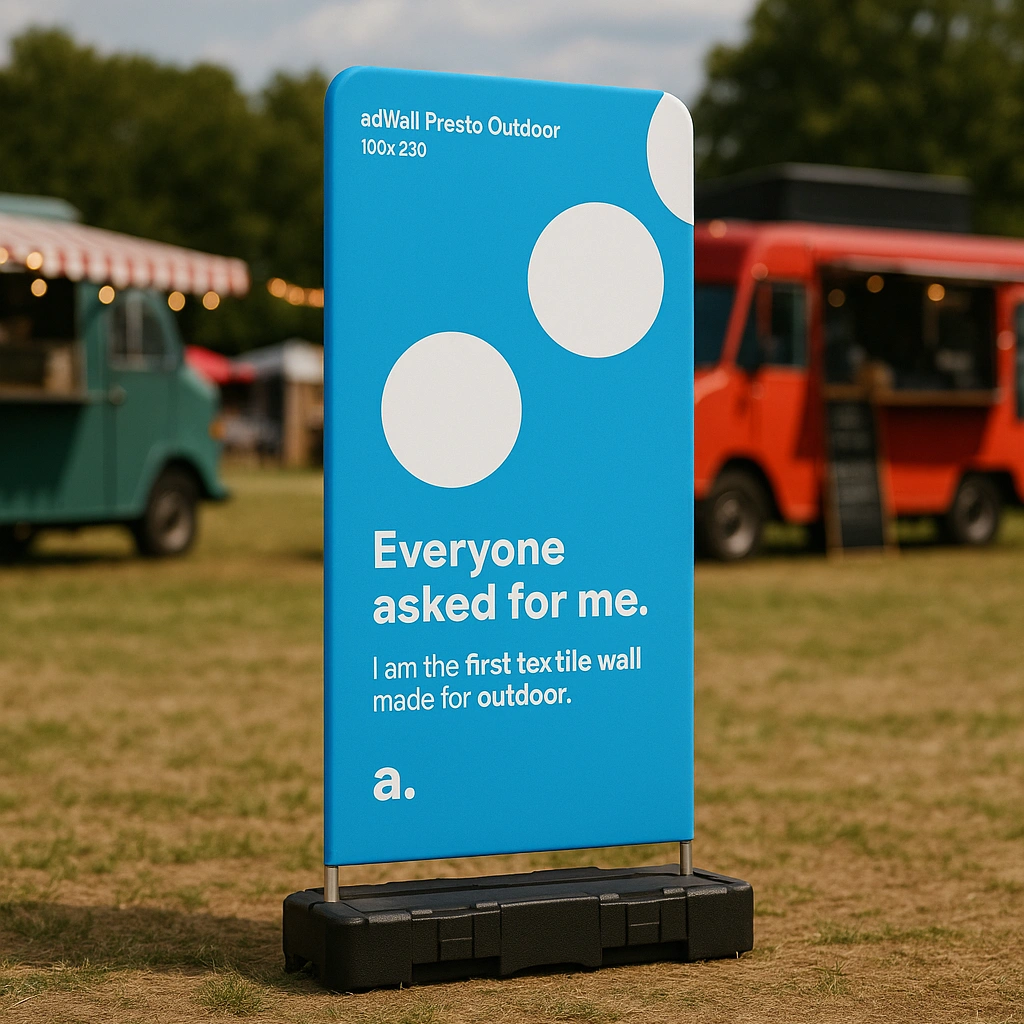 Advertising walls for outdoor events – make an impression on the ground
Not every display wall can withstand the elements. Outdoor events are a true test for any structure – and any brand. If you're planning to showcase yourself outside, choose an advertising system that rises to the occasion. Discover what an outdoor wall looks like – one that isn’t afraid of rain, sun, or uneven terrain – and see what your brand gains by going outdoors.